Violent Consumption: Cindy Sherman: Imitation of Life
Curated by Philipp Kaiser and originally shown at The Broad in 2016, Cindy Sherman: Imitation of Life at the Wexner Center for the Arts features a detailed compilation of work from one influential female photographer. The exhibit, which spans two floors, four rooms, and forty-one years of Cindy Sherman’s career, presents a comprehensive look at her visual oeuvre. Sherman’s self portraiture appropriates various modes of viewing—movies, magazine centerfolds, classical painting, pornography— in order to create scenarios that comment on the artificial nature of the self and, more specifically, women. Sherman uses larger-than-life prints, over-exaggerated costumes, identifiably fake props, and sloppy makeup, to create self-portraiture that borders on parody. In using these devices, Sherman obscures herself so greatly that the viewer often forgets they are looking at a portrait of the artist; these photographs are simultaneously of her and not of her at all. However, Sherman advances the notion of a self-portrait almost thought inverting it. As if looking through a mirror, she presents a reverse image of the self in her consciousness of the way women have traditionally been displayed and received in art and mass-media. Much of her work, in critiquing the portrayal of women, enters into a realm of trauma that, in turn, reveals something darker about the way in which the female body is consumed (violently) by audiences of visual culture.
Imitation of Life’s first room opens with some of Sherman’s early work, “Untitled Film Stills” (1977-80), “Murder Mystery” (1972-1977) and “Rear-Screen Projections” (1980), to foreground her interest in creating characters: Sherman embodies the young housewife, the hysterical woman, the sultry librarian, and the waspy old lady. In this first gallery, the simplistic framing and orderly arrangement of photographs creates a continuity of style between her early work. The majority of the photography here is rendered in black and white, organized with identical frames and matting, and displayed in grid-like rows. The titles and dates for each of the pieces is interestingly de-emphasized; instead of creating a label for each photograph, the museum groups the corresponding dates and titles for each image onto a collective label positioned away from the works.[1] In this way, Sherman’s series are almost suspended in time as the viewer is not bombarded by temporal context.
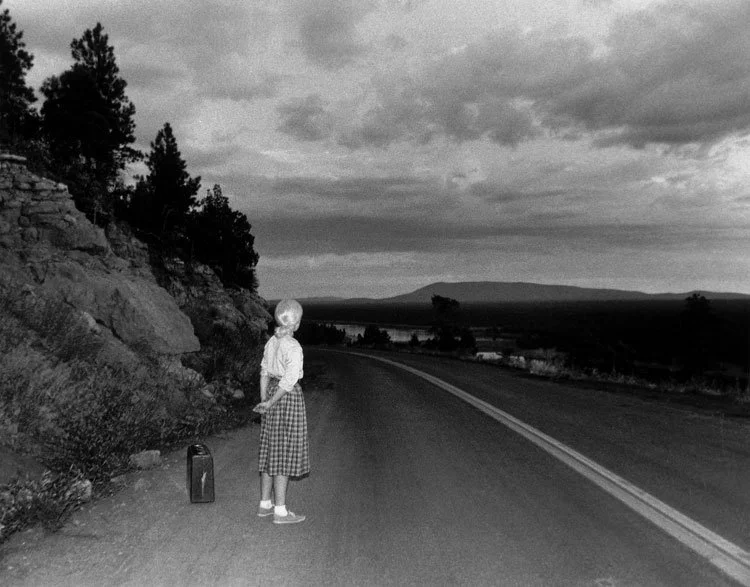
While “Untitled Film Stills” clearly draws from twentieth-century Hollywood stereotypes, many of the images do so with an underlying sense of darkness and violence. Her photographs do not only represent conventional female gender roles but they allude to an inherently violent connection between the viewer and the submissive, often sexualized, female subject. In a few examples from “Untitled Film Stills,” Sherman embodies the damsel in distress and the sexualized victim, and these portrayals align the photographs with slasher films, a sub-genre of horror. Slasher films, often “made to feed the fantasies—misogynistic, masochistic, or sadistic—of young men,” usually adhere to a set of character, lighting, location, and gender conventions, all of which Sherman appropriates in Untitled Film Still #48.[2] By exhibiting and then subsequently destroying the female character, slasher films use the female body to intrigue the male viewer by offering moments of arousal amidst the horror. The rural location, dark setting, suspenseful framing, and lone female figure in this photograph echo the visual aesthetic of a horror film, and in doing so, allude to an implicit violence enacted upon an unsuspecting woman.[3] The photograph captures a young woman standing on the side of a dark road with a suitcase as she looks out at the landscape with her back turned to the camera. There are no cars, houses, or street-lamps to indicate the presence of other people except for the mysterious source of light that harshly illuminates her figure. The bright light that floods the bottom left corner of the frame positions the viewer inside of a car, as if the headlights are what casts light on the scene. Because the figure turns her back to the camera, it appears as though she is unaware of, or at least unsuspecting of, the presence of someone else. However, the woman’s suitcase and her position on the side of the road could conversely imply that she is waiting for someone to pick her up. The ambiguity of the scene creates a suspenseful, ominous tone that aligns the photograph with the conventions of a violent, slasher film in which the female subject is often sexualized and then obliterated.
Sherman’s work in “Fairy Tales,” “Civil War,” “Disasters,” and “Sex Pictures” produced from 1985 to 1992 and shown in the exhibition’s second room, makes the implicit link between violence and viewership that was present in her earlier work more explicit. These series represent a departure, thematically and visually, from the photos in the previous and subsequent sections of the exhibition. In contrast to the simplistic, orderly arrangement of Sherman’s small black and white photographs, this room exhibits unframed large-scale prints against nearly black gallery walls. The unorthodox dark walls and absence of framing unsettles the viewer by usurping conventional modes of display within the art gallery. A smaller room off to the left projects Office Killers, a slasher movie that Sherman co-wrote and directed. Her involvement with this film makes the connection between the grotesque nature of the images in this second room and the horror-film genre more clear. Unlike her work in “Untitled Film Stills,” Sherman completely removes herself from “Sex Pictures,” “Fairy Tales,” and “Civil War,” or if she is present within the frame she is deeply obscured and serves as a representation of the abject.
Untitled #264 from 1992 provides an unsettling portrait of a mangled female body comprised almost solely of prosthetic parts. The large-scale print confronts the viewer directly upon entering the second room; its dimensions measure 50 1/16 x 75 1/8 inches and the richness of the purple and red hues of the photograph demand it be looked at. This image simultaneously abhors and intrigues the viewer: while its subject matter is graphic and unsettling, its size, dramatic coloring, and placement cause the onlooker to gravitate towards it. The subject in this photograph clearly operates within the trope of the reclined female nude. In the Western visual canon, Venuses and Danaës sprawl out against unmade beds, gently covering their pubic area with long, slender hands, as the artist displays them against an interior backdrop.[4] Here, while the subject’s position quotes classicized images, Sherman exaggerates the suggestions implicit within these traditional modes of representation. The only sections of the female body Sherman emphasizes in Untitled #264 are the sexually serving ones: the breasts, legs, and vulva. Using prosthetics and artificial parts, Sherman constructs a body that is devoid of the non-sexual; in other words, this figure has no torso, no neck, no arms and is reduced to her large, fake breasts and vulva. The subject wears a small tiara on her head and its presence within the scene almost ridicules the wearer, functioning as a part of Sherman’s parody. Her female subject is rendered in an incredibly vulnerable position with her legs widely spread; despite this, the subject sits up and acknowledges the viewer by maintaining a strong stare. Sherman affords the female a sense of agency here since she does not cower from the viewer’s scrutiny but instead she opens her legs deliberately for him.
To highlight the fact that the reclining female is often rendered through the male gaze in service of the male gaze, Sherman dramatically widens the subject’s legs to display the entire vulva. Throughout art history, male painters have produced sensual portraits of women but they rarely show an explicit image of female genitalia. Nothing is subtle or suggestive about this photo; it is overtly sexual and acknowledges the voyeuristic intention of the artist and viewers of this tradition. Therefore, Sherman’s photo comments on the empowered position of the male artist/viewer in their subjugation of female subjects. In Untitled #264 Sherman creates a parody and a grotesque mockery not of the female form, as it may at first appear through the distorted body, but the male gaze. Her use of prosthetics, body catalogues, and artificial limbs allude to the idea that this body has simultaneously been constructed and destroyed, pieced together by a collection of sex pictures. In this way, Sherman comments on the female body as abject and disfigured in its function as an object of the male gaze.
In some earlier works, Sherman draws from pornographic references, as opposed to art historical ones, to re-appropriate the reclined female nude. Her series “Centerfolds” and “Fashion Pictures” are shown towards the end of the exhibit, and the choice to group them together details the way that both series reimagine images of women in magazines. The horizontal orientation of “Centerfolds” situates these photos within the tradition of pornographic men’s magazines, but instead of being overly sexualized, the subject is shown in a state of discomfort and terror. In Untitled #86 from 1981, Sherman photographs herself in a derivation of the fetal position as she vulnerably drapes an arm across her stomach and looks off into the distance blankly. She is wet, likely sweating, and this natural yet unflattering bodily reaction to fear seems out of context to the viewer. While the medium Sherman appropriates here is that of a pornographic magazine, the subject matter seems more in line with an advertisement for a horror film or a still from a slasher movie since the subject’s sweaty body, open mouth, and submissive body language indicate that she is terrified and in pain. Critic Alex Greenberger more explicitly reads “implications of rape or abuse, almost certainly at the hands of men” within these photos.[5] Sherman’s critique of female representation in “Centerfolds” teeters into a realm of violence and trauma. In the series she appropriates the pornographic centerfold by creating scenarios that suggest fear and violence, as opposed to sex and desire, in order to comment on the way in which women are violently consumed in visual culture.
The last few rooms of the exhibition showcase series of Sherman’s photography that seeks to disorient the viewer by appropriating certain “types” of women. Between 1988 and 1990 Sherman completed a series entitled “History Portraits,” where she reproduced classic works from the Renaissance and Baroque eras. Featured in the exhibit’s third gallery, these portraits “belie any moment of historical accuracy,” and their extreme self-construction and obvious falsity align them with the grotesque nature of her earlier work.[6] “History Portraits” and a later series “Clowns” both infuse conventional characters with references to horror and the abject. Whereas clowns are viewed as sources of entertainment and humor, Sherman uses disturbing face-paint, fake teeth, frightening grins, and ghastly wigs to disorient the viewer. Similarly, in Untitled #216 from “History Portraits” Sherman stiffens and taints a portrait of the Madonna and child with horror. Unlike typical images of Mary feeding the Christ-child, the Madonna of this photograph does so with an artificial breast. Her chest does not sag or hang realistically, but the construction of Mary’s body ignores conventions of gravity in its unsettlingly synthetic nature. This representation of the Madonna borders on mockery as it comments on the way male artists of the Renaissance often portrayed the female body by compartmentalizing it and stereotyping it.
Sherman’s work challenges photography’s association with a portrayal of truth. In contrast to a recent exhibit at the Cleveland Museum of Art, Riches to Rags: American Photography in the Great Depression, Cindy Sherman: Imitation of Life explores how the politics of the subject and “the real” can be explored through postmodern self-portraiture. Whether seen through advertisements that emphasized the buying power of consumers or FSA photographs that portrayed the resilience of American individuals, Riches to Rags pulls from a diversity of photographic styles to demonstrate how Great Depression era photographers sought to empower the individual. Sherman similarly articulates a crisis within American society but she does so through opposite means of representation; instead of representing the power of the American through documentary modes, Sherman comments on the way that female agency has been undermined in visual culture by appropriating character tropes. Even though many view her photographs as “otherworldly [spaces], in the realm of the of the fictional, dreams, and the theatrical,” they serve as thoughtful comments on the state of American culture. (FOOTNOTE, book) While FSA photographer Dorothea Lange was criticized for posing her subject in the esteemed Migrant Mother of 1936, Sherman’s photographs are unapologetically constructed. In this way, Sherman’s work and its reception reflect a different era of American photography, an era which allows the medium to transcend the realm of literal representation. While her photographs subvert depictions of the real, Sherman comments on the obscured and problematic view of female individuals in American visual culture.
The title of this exhibition, Imitation of Life, situates Sherman’s photography within the domain of reproduction and emulation. Instead of engaging with a pursuit of total truth and accuracy, her photographs derive meaning through appropriating types. In his book Crisis of the Real, Andy Grundberg situates Sherman’s photography within the postmodern tradition by identifying a depthless-ness and a “self-conscious awareness of being in a camera-based and camera-bound culture” as a critical aspect of her photography.[7] She unapologetically uses aspects of this camera-based and bound culture in order to critique a representation of women in media. Sherman affords herself agency as she assumes the role of both subject and artist, character and maker; she is the sole creator and poser within these photographs, yet her content is inherently based in subject matter outside of herself. While this tension exists in her photography, it only emphasizes the impact of her work. Sherman’s thoughtful and consistently explored linkage between violence and consumption of the female in American culture provokes viewers to think about the ways in which women have been relentlessly subjugated and appropriated through mass-media, art history, and visual culture.
Notes:
[1] The rest of the captions are displayed in this way throughout the other rooms of the exhibit as well. In order to attribute a specific title and date to an image, one has to walk to the corner of the room and carefully scan a block paragraph of titles and dates to discern which identification corresponds with which image.
[2] Richard Nowell, “‘There’s More Than One Way To Lose Your Heart’: The American Film Industry, Early Teen Slasher Films, and Female Youth,” Cinema Journal, 51, no. 1 (2011): 115.
[3] Mary Gabrielle Strause, "“You’re Next” — Typical Conventions of Slasher Cinema.," Medium, March 20, 2016, , accessed November 11, 2017, https://medium.com/@marystrause/you-re-next-typical-conventions-of-slasher-cinema-77f480990ab1.
[4] While this iconography repeats itself consistently throughout Western art history, visual allusions to the trope of the reclined female nude can also be found in pornography and other more contemporary forms of media.
[5] Alex Greenberger, "The Dark Side of Cindy Sherman," Artspace, October 24, 2013, accessed November 12, 2017, https://www.artspace.com/magazine/art_101/art_market/the_dark_side_of_cindy_sherman-51746.
[6] Museum label for Cindy Sherman, History Paintings, 1988-1990, Columbus, OH, Wexner Center For the Arts, October 29, 2017.
[7] Andy Grundberg, Crisis of the Real: Writings on Photography since 1974 (New York: Aperture, 1999), 8.