Exhibition Review: From Rags to Riches
The Cleveland Museum of Art’s exhibition From Riches to Rags: American Photography in the Depression features a collection of commercial, government commissioned, and abstract photos taken by American photographers throughout the 1930s. The selection of works represents a particular way in which American artists sought to reconcile their economic anxieties and hopeful aspirations for the future during the Great Depression. The curatorial statement, which confronts the viewer directly upon entry, identifies major paradoxes amid the collection, where the arrangement of images and accompanying text highlights the disparities between urban and rural, abstract and representational, abundance and dearth. The exhibit articulates these binaries through juxtaposing two different approaches to photography that arose during this time— a modernist method and a documentarian one. The modernist uses photography as a medium for personal expression, whereas the documentarian interprets photography as a representation of truth; however, as this exhibition suggests, both the former and the latter attempt to construct a visual representation of American reality. The content and formal qualities found in a number of these pictures suggest the emergence of a theme that the curatorial thesis seldom explores, the role of the individual amid the fraught political environment of time. Overall, the layout provides an effective, subtle demarcation of the central paradoxes present in photography as a new artistic medium. However, the viewer of this exhibit may have realized something more nuanced had the curatorial thesis and wall texts interrogated ideas concerning the power and resilience of the individual.
Beginning with the larger curatorial statement and moving through the exhibit clockwise, the photos are separated into three distinct thematic categories; each of the walls depicts either FSA documentarian images, abstract photos of nature and rural life, or commercial photography. The first series to the right of the curatorial statement consists mainly of FSA commissioned images that deal with subjects of deprivation and migration. Some of the photos depict poor, public spaces in New York while others seek to portray the devastating realities of sharecropping in the south, the Dust Bowl, and the Oklahoma drought. These photos provide “visual testimony of people’s distress and hardships,” and their accompanying wall labels address the geographic specificity and documentary approaches to each image as opposed to their artistic compositions. Rather than analyzing the formal qualities of Arthur Rothstein’s Dust Storm, Cimarron County, for example, its adjacent label includes a long quote from Rothstein in which he explains his documentary work with the FSA. By incorporating quotes from various FSA photographers, the wall labels highlight the photographers’ interest in the production of truth, as they sought to capture “true subjects of human nature.” The labels for this section foreground the binary between photography as an art form and photography as a method of expressing truth and the writing acknowledges that even though these photos are arranged in a gallery, this what not their original realm of display. Unlike conventional pieces of “high art,” the FSA photographs from the 1930s were taken in order to advance a social agenda and document communities in peril. In a chapter from his book A Staggering Revolution, John Raeburn explains that FSA photos were never meant to be exhibited in a museum, but instead he stresses their “utility as handmaidens to reform.” However, these images should not be narrowly considered, for they possess artistic merit of their own and their place in the Cleveland Museum of Art elevates them to an aestheticized realm. While the wall labels only briefly discuss the formal qualities of the FSA images, a more Szarkowskian approach—by analyzing the stylistic and compositional aspects of the photos—would uncover the images’ emphasis on the fortitude of the American individual.
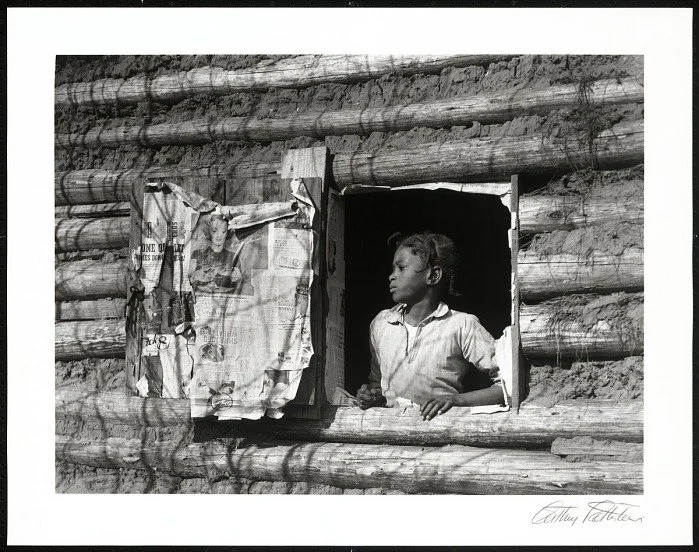
Arthur Rothstein’s gelatin silver print Girl at Gee’s Bend, Alabama from 1937 artfully epitomizes the notion of the resilient, strong individual despite racial prejudice, poverty, and economic depression. Unlike many FSA images, Rothstein included his subject's name, Artelia Bendolph, along with her photograph. In recording the young girl’s full name, Rothstein affords her autonomy and dignity, something echoed in the composition and framing of the photo. This image more literally depicts Artelia Bendolph in profile, staring out of a window that is crudely insulted with magazine paper instead of glass. The log cabin’s interior darkness provides a plain backdrop by which Rothstein highlights the distinct features of her hair and face. Her body positioning and good posture come to symbolize her agency and strength. Rothstein’s composition also juxtaposes the idea of the commercial against the rural by capturing this girl as she gazes past the makeshift window of newspaper and magazines. These tattered pages feature faint advertisements which can be read as representations of commercialization and print culture, something that Bendolph is very much removed from by living at Gee’s Bend. The image grapples with the tension between rural life and modernity: the girl clearly lives in poverty but she is looking towards the signifiers of an urban, commercial life. The wall label informs the viewer of Bendolph’s social status and the poverty at Gee’s Bend, a black sharecropping community in Alabama, although it foregoes any discussion of the image’s artistic qualities which emphasize the irrepressible American individual and the paradoxical aspects of life in the 1930s.
These images of displacement and anxiety are punctuated by the exhibit’s second section which mainly features photographs of nature taken by artists such as Ansel Adams, Ralston Crawford, and Alfred Stieglitz. This second sampling, significantly smaller than the first, that spans the gallery’s eastern wall, offers a more abstract depiction of the natural world devoid of humans. The exhibition juxtaposes this wall of abstract and landscape photos against the former images, FSA photos and urban visions of New York City, in order to draw attention to the vast range of photographic style and subject matter being captured at the time. This section completely deemphasizes the power of man through the fact that none of the images depict people; instead, the focus of the pictures is on a particular vision of America’s natural beauty. As the accompanying wall labels explain, these photographs trend towards Modernism in that they serve as clear sources of aesthetic pleasure, more in line with conventional notions of “art.” Instead of photographing the devastating effects of the Great Depression, Ansel Adams, Edward Weston, and other artists escaped to the mountains of Yosemite and the sand dunes of Oceana, California to capture timeless and uncharted landscapes. The wall labels in this section almost exclusively discuss the detail, texture, and composition of the photographs, and in doing so, they establish this section as a departure from the first in terms of subject matter and artistic intent. The abstract cropping and the dramatic interplay of light and shadow among these photos provides the viewer with a very different effect than the exhibition’s first set of pictures. The abstractions here challenge what photography can accomplish as an autonomous art form where each of the photos claim a significance and aesthetic importance, where objects are “read as symbols.” A Szarkowskian lens lends itself to the investigation of these photos since they were clearly taken with an awareness of formal techniques .
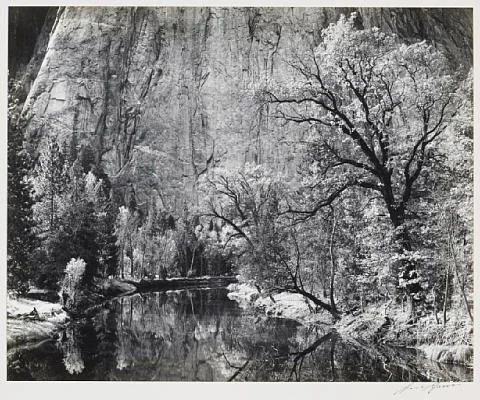
For example, Ansel Adams imbues his 1939 Merced River, Cliffs of Cathedral Rocks, from Yosemite Valley Portfolio III with spiritual and peaceful qualities. The lake is calm and still and the looming trees cast their reflection in the water to create the illusion of nature compounding onto itself. This image explores the sublime nature of California’s landscape and almost evokes a religious significance by capturing an awe-inspiring, Godlike scene. While devoid of people, this photograph still comments on the role of the individual during the chaos of the Great Depression; however, the labels do not allude to this connection. Although no people exist inside Adams’ frame, the viewer implicitly recognizes the presence of at least one person—the photographer. In this way, his photograph inspires personal introspection and a more contemplative relationship with nature as he bears witness to beauty of the environment.
The exhibit’s third section, showcased on the long wall opposite the FSA images, explores advertisements, commercial photography, and photos with surrealist qualities inspired by Modernism. The composition of many of these commercial photographs seems reminiscent of still life paintings, and photographers such as Paul Outerbridge, as the wall labels suggest, were inspired by “traditional [painterly] genres.” A common thread that unites these commercial photos deals with the idea of abundance and economic comfort. In his 1936 image Cheese and Crackers, Paul Outerbridge simply orders two blocks of cheese, eleven saltine crackers, and one knife across a wooden cheese board. The plate provides more than an ample snack to its patron and alludes to the idea of abundance, for there are merely eleven crackers on the board but there are two substantial blocks of cheese. The subject matter here seems rather insignificant and banal, but its orderly composition reflects larger goals of 1930s advertisements: to project an image of stability. Because the Great Depression uprooted so many American families, successful advertisements of this period sold Americans on the idea of comfort and financial security. The formal qualities of many of these photos highlight this notion in their orderly arrangements and traces of symmetry. In some ways the recognizability of the subject matter— condiments, cheese, eggs, dishes, lipstick, etc.— and the orderly compositions did not challenge or assault the viewer, but provided them instead with the stability they desired amid this chaotic decade.
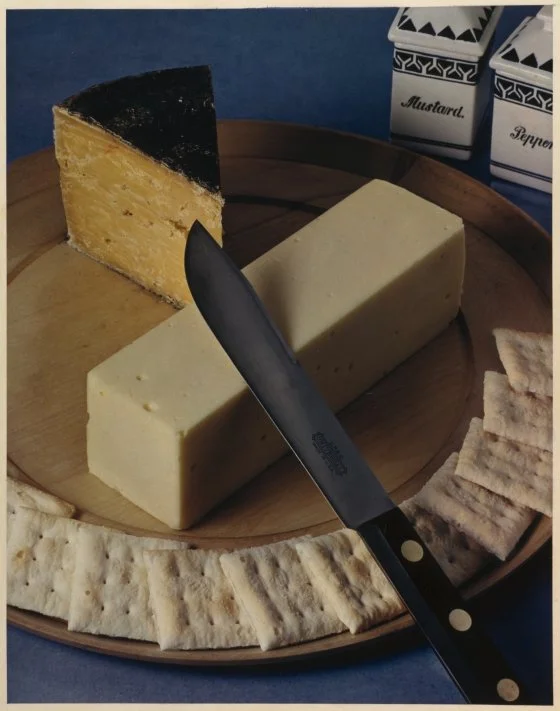
However, while the wall labels do not explore this theme, Outerbridge’s photograph also speaks to the powerful role of the American individual during the 1930s. Cheese and Crackers seeks to empower the individual as a consumer with ultimate choice. As advertisements and commercial photography emerged in the 1930s, so did the concept of the buying power of the American purchaser. The simplicity of the objects arranged in the Cheese and Crackers do not overwhelm the viewer, but present her with a choice. The single knife suggests a kind of individual authority and control. Positioned in the righthand corner, the handle outstretches towards the viewer, inviting them to pick up the utensil and help themselves to this organized assortment of food. Its presence, unaccompanied by any indication of others, emphasizes one autonomous consumer.
The curatorial arrangement of these photographs proves as important to the effectiveness of the exhibit as the content of the images themselves. Whereas newspapers and influential media, such as Life Magazine and Survey Graphic, would have published the documentarian style photos, modernists attempted to elevate the status of photography as an art form and afford it a place in museums. The exhibit curators kept images from these two different photographic approaches separate from each other in order to create a more dramatic contrast between the schools of photography that were present during the Great Depression. The layout comments on a central paradox of 1930s photography, the production of images of poverty and economic crisis as well as advertisement photos that showcased abundance and excess. Because advertisements became ubiquitous in the 1930s, it could have been effective to mimic this idea in the exhibit’s layout. For example, instead of separating the different styles of photography onto distinct walls, interspersing the commercial photos in between the images of deprivation and hardship could have created a starker juxtaposition between facets of American life during the Great Depression. This alternative organization also would have mimicked the pervasive nature of commercial photography at the time.
Further, the divided layout speaks to the exhibit’s tension between material culture, the documentary images, and aestheticism, the modernist photos. Jules David Prown would certainly view the two books that the exhibit includes in display cases in the middle of the room—one of which is Walker Evans’ American Photographs—as meaningful aspects of material culture. As well, surely the FSA photos would fall into this category because of their clear interest in portraying “a branch….of cultural history.” The diversity of subject matter and photographic styles—documentary, abstract, landscape, advertisement, cityscapes—found in Riches to Rags represents to the breadth of work that the exhibit addresses. It is interesting to consider the ways in which photography can exist at multiple places at once, for many of these photos were not intended to be hung on the walls of a gallery. However, by being displayed along pieces of “high art,” advertisement photos by Edward Steichen and Arthur Rothstein’s FSA images become aestheticized and appreciated for their formal beauty. The layout of exhibit provides a subtle breakdown of the binaries present in 1930s photography; although, the curatorial thesis ignores the notion of the power of the American individual, which is an idea clearly present in the content and formal qualities of the documentary and commercial images alike.
Citations:
Brown, Jules David. "The Truth of Material Culture: History or Fiction?" In American Artifacts, 11-27. East Lansing, MI: Michigan State University Press, 2000.
Cleveland Museum of Art. Museum label for Arthur Rothstein, Girl at Gee’s Bend, Alabama. Cleveland, OH, September 10, 2017.
Cleveland Museum of Art. Museum label for Helen Levitt, New York. Cleveland, OH, September 10, 2017.
Cleveland Museum of Art. Museum label for Paul Outerbridge, Cheese and Crackers, Cleveland, OH, September 10, 2017.
Raeburn, John. A Staggering Revolution: A Cultural History of Thirties Photography. University of Illinois Press, 2006. http://www.jstor.org/stable/10.5406/j.ctt1xcnj9.
Szarkowski, John. The Photographer's Eye. New York :Museum of Modern Art : distributed by Doubleday, Garden City, N.Y., 1966.
Tannenbaum, Barbara. "From Riches to Rags." Cleveland Museum of Art. June 14, 2017. Accessed September 19, 2017. https://www.clevelandart.org/magazine/cleveland-art-julyaugust-2017/riches-rags.